
Hockey's Giant Goalie Problem: Nowhere To Shoot
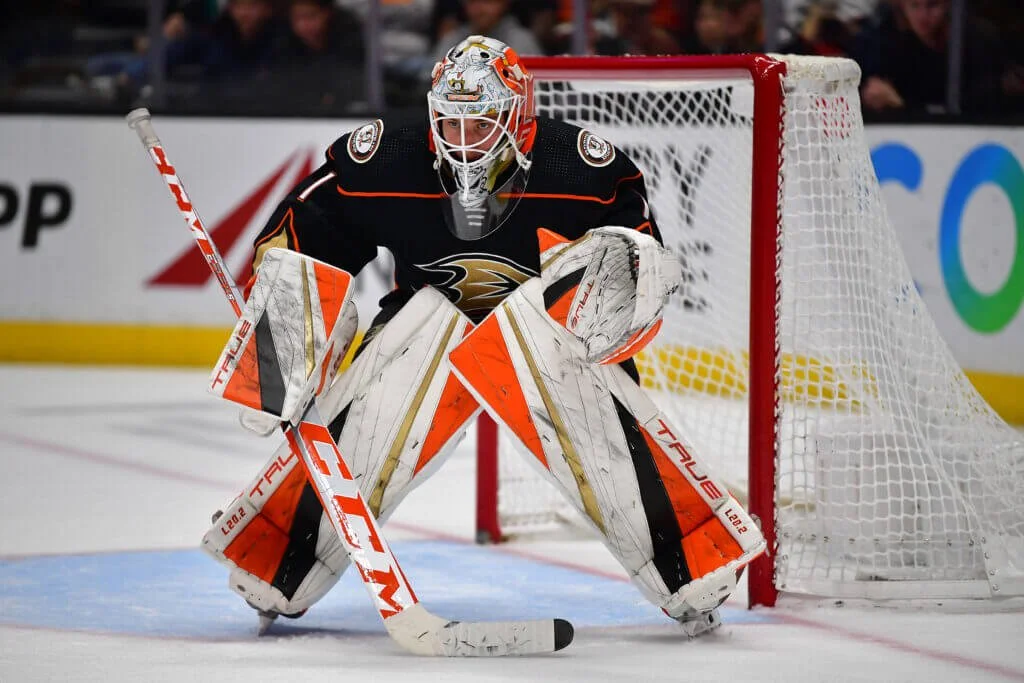
“The Ears Have It” is perhaps the most indicative thing about scoring said on HNIC in these playoffs. The new shooter’s target is not between the legs or under the armpit of goalies. No, it’s that tiny space right next to a goalie’s ear. And with the traditional targets cut off by butterfly goalies the best scorers are honing in like drones on the lobes.
That scoring in the NHL is reduced to such a tiny target reflects the radical shift in skills for goalies. With the tumult of crashing players around the net goalies have gone from the smallest player to the tallest, able to cover virtually all the shooting target. And strong enough not to get jostled out of place.
If goalies take away sniper’s spot by standing up— as used to be the style—then elite shooters will put the puck between his legs or inside the posts. As happened for a century. Till goalie coaches changed the equation.
It’s a change that dates back to the 1990s and it has caused an evolution in the sport. One person not fond of the Goliath goalies was the late Ken Dryden, the Hall of Fame netminder with six Stanley Cups. He described it as, “The problem isn’t the game. The problem is the goalie, who is changing the game”.
In our column from 2018 we recalled a unique encounter with Dryden. “In 2001 I was driving to the media hotel in Sunrise, Florida, on my way to covering the NHL Draft. My passenger as we drove through a teeming downpour was Ken Dryden, then president of the Toronto Maple Leafs, who’d grabbed a ride with me on a rainy February afternoon.
As we made our way though the monsoon we talked how the game was being played at that time. It might have been the ugliest brand of hockey in the modern era— a suffocating brand of rugby on skates, slower players restraining skill players. Unlimited interference in the offensive zone. Unreliable refereeing. Fighting still an integral part of the game’s strategy.

What I remember most about the drive was Dryden talking about the size of NHL goalies. Which should have been unsurprising. After all, the former All Star goalie and six-time Stanley Cup winner had been publicly examining and re-examining the role of his position on the ice since he arrived in Montreal in 1971. His book The Game is the definitive sports autobiography.
So it was hardly surprising that he had returned to the subject of goalies in The Atlantic in 2018. As he was in 2001, Dryden was concerned that hockey’s fine balance of skill and imagination is out of whack. The title of the piece “Hockey Has a Gigantic-Goalie Problem” sums up his thesis.
“While scoring remained near its typical levels, the art of scoring them was more luck than skill. In short, if today’s padded-up giants can see the puck they’re going to stop it. “This game, one that allows for such speed and grace, one that has so much open ice, is now utterly congested… Never in hockey’s history has a tail so wagged the dog.”
Dryden reviewed the evolution of the position from goalies’ bodies protruding above the cross bar to having their entire body blocking the ice surface below them. “Pads that had been made of heavy leather, deer hair, and felt were replaced with nylon, plastic, and foam rubber. These lighter materials, which made the pads less awkward to move around in and less tiring to wear, could then also be made bigger. And bigger equipment, covering a body now in position below the bar, filled even more space.”
Dryden explained how a properly positioned 6-foot-3 (or taller) goalie can now block all avenues for the puck— from his knees. “But really, in that equipment, with those body strategies, why get up? Why move? What better puck-blocking position could he take?”
The response from coaches and shooters? “Rush the net with multiple offensive players, multiple defensive players will go with them, multiple arms, legs, and bodies will jostle in front of the goalie, and the remaining shooters, distant from the net, will fire away hoping to thread the needle, hoping the goalie doesn’t see the needle being threaded, because if he does, he’ll stop it.”
It’s not a formula Dryden liked. “All the players’ amazing skills, developed in hours of practice, visualizing and dreaming in basements, on roads and local rinks, in drills with coaches and expert teachers, their minds and hands now able to move as fast as their feet, to find and use all the open ice that is there. But with so little open ice where open ice matters, for what?”

He contrasts how basketball solved its size problem: introducing the three-point line to open up scoring in what was becoming a stalemate beneath the hoop. “If a big guy can’t pass and shoot, there’s no place for him. With big guys dispersed and away from the basket, little guys now even get rebounds. All 10 players are involved. All 10 players can have a role. All 10 players, on the best teams, and on even better teams in the future, need to have a role to win. This NBA game, played on a much smaller surface than a hockey rink, is now far more open, much less congested.”
Dryden’s solution was a reluctant one. “The clever cat-and-mouse game between goalies and shooters has run its constructive course. The goalies, by winning, have changed the game. So the net must be made bigger. Maybe only six inches or a foot wider, maybe only six inches higher. And only for those in junior and college leagues and above.”
If Ken and I were riding in that same car again, I’d tend to agree with him about a bigger net. But I would offer one other suggestion to open up the game. As soccer does with its striker, station your top scorer at— or near— the opposing blue line, even when play is in your own zone. Make the opponent choose between a 5-on-4 attack or allowing a breakaway at his own end of the rink. Stretch the rink.
As 4-on-4 does now it will reduce the congestion in the scoring zone, promote skill, create the drama of breakaways and goals off a rush and eliminate all but the best skaters. (Much culling of slow skaters has been done but more remains). I might also put forward that skaters cannot leave their feet to block shots and passes.
Hockey’s thinkers have some challenges ahead. Conversations must address those challenges. Like a conversation on a rainy day 25 years ago with hockey’s most fertile mind.
Bruce Dowbiggin @dowbboy is the editor of Not The Public Broadcaster A two-time winner of the Gemini Award as Canada's top television sports broadcaster, his 2023 book Inexact Science: The Six Most Compelling Draft Years In NHL History, was voted a Top 20 greatest professional hockey books of all time by bookauthority.org . https://www.amazon.ca/dp/1770415300?linkCode=gs2&tag=uuid0a1-20 His previous book with his son Evan, Deal With It: The Trades That Stunned The NHL And Changed Hockey is now available on Amazon. His new poetry collection In Other Words is available via brucedowbigginbooks.ca and on Kindle books at https://www.amazon.ca/dp/106980270