
Podcast Studies: Practice into Theory
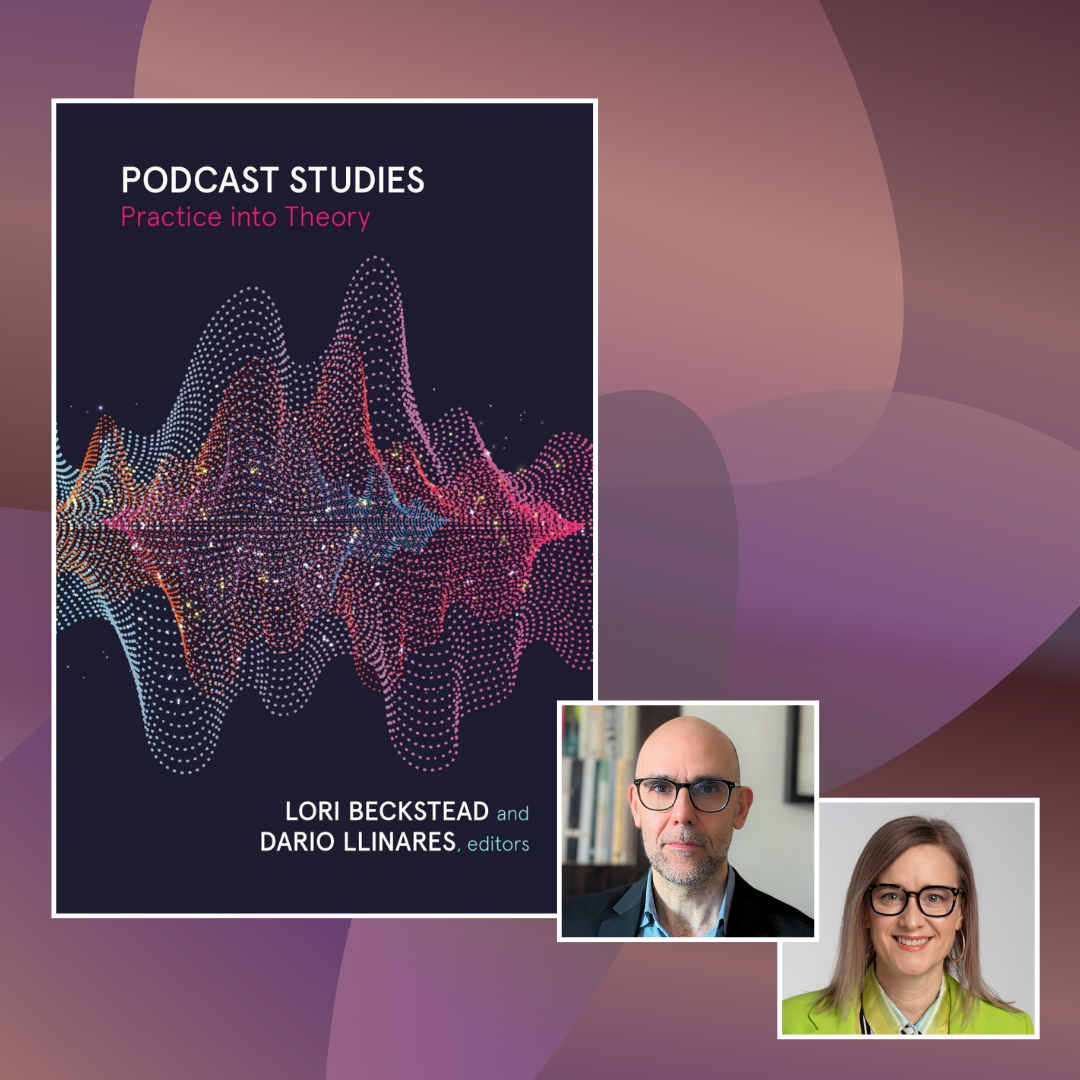
Podcasts have become so ubiquitous it’s easy to forget they are relative newcomers to the digital broadcast scene. For this reason, a recently released academic work - Podcast Studies: Practice into Theory- is an important read for podcast listeners, podcast content creators and those who promote and curate this rapidly evolving medium.
Though not an “easy read,” among other things, the book’s eighteen essays outline podcasters’ take on the journey from radio broadcasting into audio and visual productions, noting increasing engagement via YouTube, with graphics and other special effects. Nowadays podcasting has grown from being a niche technology into a mainstream source of information.
In the past twenty years since podcasting technology evolved to let users easily get new episodes and subscribe to podcast feeds all major digital players have adopted the format as a lucrative content. Between 2008 and 2015, listener numbers nearly doubled in the U.S. with podcast fans consuming more audio than users of other formats.
The paperback version of the book appears at a time where some fear podcasts’ legitimacy may become a victim of the digital medium’s unbridled success and extreme growth and popularity. Of the collection released in paperback by Wilfrid Laurier University Press last month (November 2025), editor Dario Llinares said in an email interview he hopes the book counters “two unhelpful poles,” that he says dominate public perception of the communications format.
One is, “the naive enthusiasm that treats podcasting as a frictionless solution to impact and engagement,” while the other is, “the dismissive view that sees it as inherently lightweight or ‘dumbing down’.” “We’re in a moment where . . .podcasting looks like the perfect tool: a medium that can take complex ideas and make them publicly accessible without dumbing them down,” says Llinares, an academic, author and podcast expert of the book he compiled with co-editor Lori Backstead.
“In my experience—as a teacher and a listener—podcasts and audiobooks can complement rather than replace reading. They offer a different kind of cognitive and affective engagement: ideas carried by tone, rhythm, emphasis, dialogue.
“So, I don’t buy the simple “dumbing down” narrative. The real question is how we design and use podcasts: are we making work that invites depth, curiosity, and critical reflection, or just repackaging everything into easily digestible soundbites.”
Though substantially an academic and instructional work, the book offers considerable insight into why podcasts have succeeded. Its essays by creators and contributors, like Stacey Copeland, Hannah McGregor, Katherine McLeod, Tanya Bell, Sheila LaRoque, and Kayla Lar-Son, are proof of that.
Yet things are changing so fast, it is hard to keep pace with the evolution of podcasting, Llinares says.“The landscape has already shifted radically in the time between conceiving the book and its publication: YouTube has become the dominant space where people “listen” to podcasts, and that migration towards visualized podcasting fundamentally alters how shows are made, how they’re consumed, and the kinds of labour and resources involved.”
Llinares says, “there’s a danger that the low-barrier, audio-first ethos that made podcasting such a democratic and experimental medium gets squeezed by platform logics, branding pressures, and video production demands. So, one key future I’m invested in is preserving and defending the relative “purity” and accessibility of audio podcasting as a space of creative, critical, and independent practice—inside and outside the university.”
Llinares calls podcasts “reflexive thinking in progress” and far from dumbing down content they give participants and listeners a chance to work “through ideas live,” . . . where “the conversation, rather than the . . . authority of the journal article or lecture, becomes the form.”
He says podcasts allow, “for serendipity, anecdote, uncertainty, emotion, and situated experience to play an explicit role in how ideas emerge and connect.” The book’s editors tried to get a range of diverse voices to highlight “one of the strengths of podcasting to capture and express authentic diverse voices ,” Llinares says.
“Diversity was central, but not in a narrow, box-ticking sense. We wanted a range of subjectivities and positions, not only across familiar markers such as gender, geography, and discipline, but also in terms of institutional role, professional experience, and modes of practice.
That meant bringing together established academics, early-career researchers, practitioners working inside and outside the university, and people whose work moves between research, teaching, activism, independent production, and public engagement. Llinares says a positive development is that the tools to create podcasts, “are more accessible than ever.
It’s easier to record, edit, and distribute audio; people are used to having podcasts woven into their daily routines. . .” Another trend affecting podcasts is advancements in AI, (which Llinares says is already offering improvements). “Tools for cleaning audio, leveling, noise reduction, transcription, translation, and search can be transformative - especially for independent producers or academics without institutional resources.”
Still, he does not see a world with fully synthetic podcasting and fears the potential for “AI slop.”
Podcast Studies: Practice into Theory
Wilfrid Laurier University Press, editors Lori Beckstead and Dario Llinareas